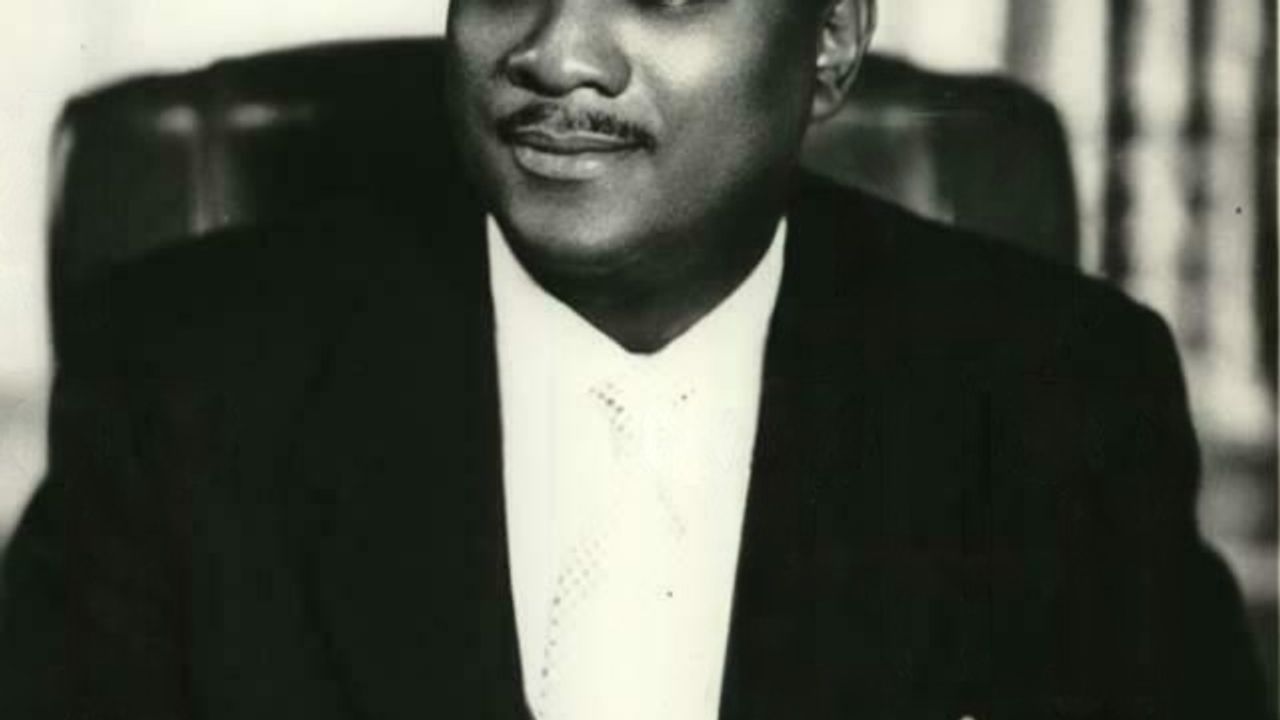
John H. Johnson
John H. Johnson
“Failure is a word I don't accept.”
Photo: Unknown / Press photo (1954) — published without copyright notice / Public Domain

Why This Person Is Included
You know Ebony. You may know Jet. What most people don't know is the business story behind them — a man who pawned his mother's furniture for his first operating capital, who became the first Black person to appear on the Forbes 400 list, and who built the flagship media company for Black Americans across sixty years of American history from the segregation era through the civil rights movement through the digital age. The magazines are the artifact. He is the curriculum.
The Story
John Harold Johnson was born in Arkansas City, Arkansas, on January 19, 1918.1 His father died when he was eight. He and his mother relocated to Chicago in 1933 as part of the Great Migration. She worked as a domestic worker; Johnson attended DuSable High School, where he edited the school newspaper and came to the attention of Harry Pace, president of Supreme Life Insurance.1
In 1942, Johnson borrowed $500 against his mother's furniture as collateral to launch Negro Digest — a monthly digest of news and opinion about Black Americans, modeled on Reader's Digest.1 He sold subscriptions by mail and distributed through Black barbershops and beauty salons. The first issue sold 3,000 copies. Within eight months, circulation had grown to 50,000.1
Ebony (1945) and Jet (1951)
Johnson launched Ebony on November 1, 1945 — a photographic general-interest monthly covering Black life, culture, and achievement.2 The first issue, an initial print run of 25,000 copies, sold out completely.2 By 1946, circulation was 400,000. By the time Johnson died in 2005, Ebony reached approximately 10 million readers.2
Johnson launched Jet in 1951 as a compact weekly newsmagazine. Jet's 1955 decision to publish photographs of Emmett Till — which Mamie Till-Mobley insisted the world see — is one of the most consequential editorial decisions in the history of American journalism.1
Building the Market for Black Advertising
Johnson's most significant business innovation was not publishing — it was convincing white advertisers that Black consumers were a viable market at national scale. He spent years making personal visits to corporate marketing directors, presenting data, demonstrating that Black consumers purchased their products at rates that justified premium advertising investment.1 He succeeded by reframing the conversation from 'doing right by Black Americans' to 'reaching a market your competitors are ignoring.'1
In 1982, Johnson became the first Black person to appear on the Forbes 400 list of wealthiest Americans, with a net worth estimated at $100 million.3 Johnson Publishing expanded into Fashion Fair Cosmetics — one of the largest cosmetics lines for darker skin tones — and into book publishing and television production.1
Constraints & Tradeoffs
The Advertising Market
The most significant structural constraint Johnson faced was not in circulation — Black readers bought Ebony and Jet in massive numbers — but in advertising. White-owned advertising agencies and their corporate clients had decided, as a matter of institutional practice, that Black consumers were not a primary audience worth targeting. This meant that despite Ebony's 400,000 circulation in 1946, Johnson initially could not sell advertising at rates that reflected that audience's purchasing power. He spent years making personal visits to corporate marketing directors, presenting data, demonstrating that Black consumers bought their products, and arguing that advertising in Ebony was a rational business decision rather than a charitable gesture.
He succeeded by reframing the conversation: from 'doing right by Black Americans' to 'reaching a market your competitors are ignoring.' Once major national advertisers began appearing in Ebony, the holdouts faced a competitive disadvantage. Johnson's persistent sales approach, repeated over years, changed the economics of Black media advertising.
What Actually Happened
First on Forbes 400; Company Sold 2016
Johnson Publishing Company remained family-controlled under Johnson's leadership until his death in 2005, then under his daughter Linda Johnson Rice as chairman. The company was the largest Black-owned publishing operation in the United States for decades. In 2016, Ebony and Jet magazines were sold to a private equity firm — the first time the publications had changed ownership. Fashion Fair Cosmetics, a separate division, was also sold.
Johnson became the first Black person on the Forbes 400 list in 1982 with an estimated net worth of $100 million. He received the Presidential Medal of Freedom in 1996. The company he built — from a $500 loan against his mother's furniture — was the flagship media property of Black American life for sixty years.
Pattern Extraction
Johnson's pattern is the market creation sell: identify a large, poorly served audience, build the media vehicle that reaches them, then spend years convincing the advertisers who fund that vehicle that the audience exists and has purchasing power. The business model requires patience at the advertising stage — building the audience before the advertising revenue follows — and persistence in the sales approach that converts institutional skeptics.
Frequently Asked Questions
- What was John H. Johnson's highest level of education? ▾
- John H. Johnson attended DuSable High School in Chicago, where he edited the school newspaper and attracted the attention of Harry Pace, president of Supreme Life Insurance. No undergraduate or graduate degree is documented in this record. Johnson later received honorary degrees, but did not hold a college credential. ⚠ VERIFY: Confirm whether Johnson received any honorary degrees and whether he attended any college courses before launching Negro Digest.
- What was John H. Johnson's net worth? ▾
- In 1982, Johnson became the first Black person to appear on the Forbes 400 list of wealthiest Americans, with a net worth estimated at $100 million at that time. No more recent independently verified net worth figure is applicable, as Johnson died on August 8, 2005.
- How did Johnson fund the launch of Negro Digest? ▾
- In 1942, Johnson borrowed $500 using his mother's furniture as collateral to launch Negro Digest. He sold subscriptions by mail and distributed the magazine through Black barbershops and beauty salons. The first issue sold 3,000 copies; within eight months, circulation had grown to 50,000. [Source: record footnote [1]]
- Why was Jet's 1955 coverage of Emmett Till historically significant? ▾
- In 1955, Jet magazine published photographs of Emmett Till's open casket — a decision insisted upon by his mother, Mamie Till-Mobley, who wanted the world to see what had been done to her son. The images brought the reality of racial violence in the American South to a national audience and are widely considered one of the most consequential editorial decisions in the history of American journalism.
- How did Johnson persuade national advertisers to buy space in Ebony? ▾
- Johnson made personal visits to corporate marketing directors and presented data showing that Black consumers purchased their products at rates that justified national advertising investment. His core argument reframed the conversation: rather than asking companies to do right by Black Americans, he argued they were ignoring a market their competitors were not yet reaching. He also used a parity argument — that Ebony deserved the same advertising consideration as Life and Look — and drew on a foreign-market analogy, describing the Black consumer market as larger and more affluent than some major white foreign markets. [Source: research_log, Forbes/Gross et al. and Johnson 1995 interview]