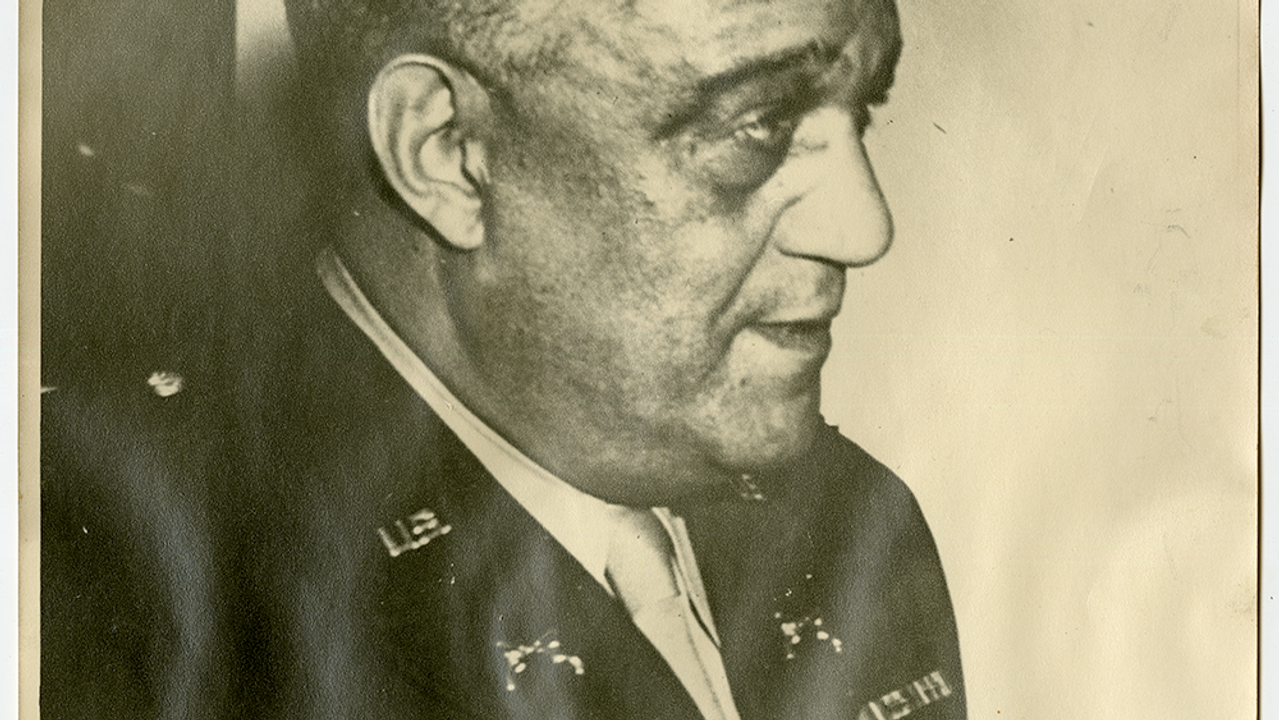
Homer B. Roberts
Photo: Unknown / KC Black History (kcblackhistory.org) / Press / editorial use

Why This Person Is Included
Homer B. Roberts was among the earliest documented Black automobile dealers in the United States, and built Roberts Motor Mart into what some sources describe as one of the first retail shopping centers in the country. He served as a sales intermediary between white car dealers and Black customers in Kansas City during the era when manufacturers refused to franchise Black dealers directly. His name is absent from the standard history of American automotive retail.
The Story
Homer B. Roberts was born in 1885 and graduated from Kansas State Agricultural College.1 He served in World War I as the first Black man to attain the rank of Lieutenant in the United States Army Signal Corps.1 After the war, he returned to Kansas City and began selling automobiles.
In 1919, Roberts began his automobile business using, as his contemporaries described it, 'a curb stone as his office' — selling used cars through newspaper advertisements targeting Black buyers exclusively.2 By the end of 1919, he had negotiated more than 60 car sales to African-American buyers who faced discriminatory treatment at white dealerships.2
Roberts Motor Mart (1923)
On July 29, 1923, Roberts held the formal opening of the Roberts Company Motor Mart — attended by more than 3,000 people.2 The new building gave him a permanent location for what had become the first African-American owned car dealership in the United States.23 Roberts sold Hupmobiles through a partnership with two Black Kansas City businessmen and with Hupmobile dealer Thomas 'Big Piney' Brown.2
Later that year, Roberts began selling brand-new Oldsmobiles — expanding beyond the Hupmobile partnership into a General Motors model.2 At its peak, Roberts Motor Mart and its associated businesses employed 55 Black workers.2
Chicago Expansion
In 1928, Roberts and business partner Kenneth Campbell Jr. moved to Chicago.2 In 1929, they opened a second Hupmobile dealership at the Hotel Grand on South Parkway — the second Black-owned automobile dealership in America.2 Roberts died in 1952.
Constraints & Tradeoffs
Roberts operated as an automobile dealer during a period when automobile manufacturers maintained exclusive franchise relationships with dealers — and refused to grant those franchises to Black entrepreneurs directly. He navigated this by positioning himself as an intermediary: serving Black customers who faced discriminatory treatment at white dealerships, while also working with white manufacturers and dealers who wanted access to Black Kansas City's purchasing power. The structural constraint was that he could not be a standard franchisee; he had to invent a role that didn't formally exist in the manufacturer's distribution model.
Verifying the specific details of his business — the exact franchise terms, the retail center claim, the scale of his operation — requires archival research at Kansas City historical institutions. This profile is written with appropriate hedging where the sources are not definitive.
What Actually Happened
Legacy in Kansas City History
Roberts Motor Mart operated in Kansas City and is documented in automotive trade press and local historical records as a significant Black-owned business in the early automotive era. The 'first Black automobile dealer' designation appears in automotive industry historical sources, though the specific scope of that claim (first Hupmobile franchisee? first Black automobile dealer broadly?) requires primary source verification.
His WWI service as one of the first Black Lieutenants in the Signal Corps is documented independently of his business career. His story represents the automotive industry's pattern of Black consumer exclusion and the entrepreneurial workarounds that Black business people developed to serve their communities within those constraints.
Pattern Extraction
Roberts's pattern is the intermediary position: when direct market access is blocked by structural discrimination, find the intersection where the discriminating system still needs what you can provide. He served Black customers who needed automobile access and white dealers who needed Black customer revenue. The intermediary position generates real value — and real dependency on the continued existence of the discrimination that makes it necessary.